Friday, September 16, 2011

Midnight in Paris, ditected by Woody Allen

Midnight in Paris is the hour of dreams. Woody Allen's latest film is the renewed ascending curve of an outstanding career with fewer downs than ups.
Back to the splendour of his earlier films, such as Radio Days or Manhattan, Allen did not put all his bets on a lesser remake of a proved success. Midnight in Paris is an original approach of an unprejudiced director.

A Man is engaged to be married and goes to Paris, with his fiancée. If Paris is the city of love and fascination, it is also the city of truth, the place where one encounters oneself, and becomes out of love with the wrong person. But in this surrealist film, love is merely a scenery for bold, yet tastefully discrete, magic events. Gil is a man who believes the age of gold to be in the past and never in the present or the future. He walks about nostalgia shops, and dreams of the twenties. Lost in an alley and sleepless, alone and bored with his constantly present pseudo-intellectual fiancée’s friend, he is suddenly taken in an old taxi, at the strike of midnight, to the real twenties where he meets his greatest idols: Cole Porter, Jean Cocteau, Buñuel, Man Ray, Picasso, Dali, Zelda and Scott Fitzgerald, Hemingway… and Adriana. Every night he stands in the same alley and every time he enters a parallel universe. He falls in love with his twenties female similar, a woman for whom the golden age was the last decade of the nineteenth century. And here, the story jumps into a farer past, the Paris of Lautrec, Degas, Gauguin, Offenbach.

The stroke of genius of the director is far from the common final revelation that makes one return to real life. No, the only revelation is the fact that Gil overcomes his fixation through Adriana choices and actions. She chooses to stay in the nineteenth century stating that the past is the place to be, whilst he realizes that each person belongs to their own time.

Unlike The Purple Rose of Cairo, where the main character accepts the ugliness of reality after leaving the universe of dreams, Gil sees the beauty of it for the first time, as he crosses a bridge, side by side to his soul mate, a French girl who, like him, loves to walk in the rain.

Let’s do it, let’s fall in love, by Cole Porter is the main musical theme, and does the job marvellously.
A note should be made to a less achieved filming of present Paris. Being himself a lover of the old days, Woody Allen captures the light of Paris past as it is represented in paintings. But he fails to grasp the essence of real Parisian light, or even Spain’s (Vicky, Christina, Barcelona). Though living in Europe, Woody Allen is heartedly American, he shoots New York with brilliancy, but hardly the rest of the world.

Yet, once again, regardless of his passion for the old, Woody Allen answers with the future, when the Present asks a question.


http://www.youtube.com/watch?v=atLg2wQQxvU

Cast and crew

Woody Allen’s long time searched alter-ego, Owen Wilson plays Gil in the main role.
Other roles: Yves Heck as Cole Porter, Adrian Brody as Dali, Corey Stoll as Hemingway, Allison Pill and Tom Hiddleston as Zelda and F. Scott Fitzgerald, Marcial Di Fonzo Bo as Picasso, Tom Cordier as Man Ray, Adrien de Van as Buñuel, François Rostain as Degas, Marion Cottillard as Adriana, Rachel McAdams as Inez (Gil’s fiancée), Michael Sheen as Paul (Inez pseudo-intellectual friend), Léa Seydoux as Gabrielle (Gil’s true love)…
Director: Woody Allen
Written by Woody Allen

Thursday, August 11, 2011

A MAN FOR ALL SEASONS, directed by Fred Zinnemann

A Man For All Seasons, directed by Fred Zinnemann is the story of Sir Thomas More, an English scholar from the sixteenth century, a Man who died for a principle. His death did not change the ways of his world, or even served future justice. No, as Tolstoy said, much later, where there is a court justice is lost. Such was the case of Sir Thomas More.

The Plot:
Henry VIII wishes to divorce Catherine of Aragon and marry Anne Boleyn a whim that partly contributed to the independence of England from the Catholic Church. For every drastic change, old laws must be destroyed and new laws written. But new laws must be created for valid reasons, not for personal interests. The system is transformed when its ways no longer support justice. Henry VIII wants a new world that holds his whish and not necessarily England’s. Only one Man stands between the king and that change, and that is Sir Thomas More, respected by all, followed by all, the monarch’s conscience. But a king of few principles needs only to eliminate that conscience. Sir Thomas is taken to trial as traitor. He is condemned.

Paul Scofield plays Sir Thomas More with the brilliancy that makes one substitute the real character by the fictional in one’s mind. Leo Genn achieved the same mastery playing Petronius in Mervyn LeRoy’s Qvo-Vadis (1951). Orson Welles played a very credible Cardinal Wolsey. John Hurt became Richard Rich, undistinguished from a true villain. Robert Shaw was wisely discrete playing the grotesque Henry VIII.

Why then, a film that enhances the curse that hits men who are defenders of noble principles, integrity, honesty becomes not dark but a redeemer of Mankind? For the same reason martyrs do: Death adds immortality to that courage, and above all to those principles.
http://www.youtube.com/watch?v=6nSx0_9TZww
http://www.youtube.com/watch?v=A-nJR15e0F4


Cast and crew:

1966
Directed by Fred Zinnemann
Based on a play by Robert Bolt A Man For All Seasons
Music by Georges Delerue
Cast: Paul Scofield (Sir Thomas More), Robert Shaw (Henry VIII), Orson Welles (Cardinal Wolsey), John Hurt (Richard Rich), Nigel Davenport (the Duke of Norfolk), Leo McKern (Thomas Cromwell), Wendy Hiller (Sir Thomas’ wife Alice), Susannah York (Sit Thomas’ daughter Margaret)…

Friday, March 4, 2011

THE NAKED JUNGLE, directed by Byron Haskin

There is a man isolated in the South American jungle. He owns a cacao plantation, a land stolen inch by inch to the Rio Negro river. Though being away from civilization since his boyish years, this man hasn’t forgotten its luxuries and refinement. In fact, he is determined to build his own kind of civilization in the middle of the jungle where everything brought there was never touched by any hands but his. A wife is part of that dream. But being unable to leave the plantation, he asks his New Orleaner brother to find one for him, a marriage by proxy. And so, a woman of great charm, refinement, sophistication, arrives to Rio Negro, brought by a boat along with her fashionable luggage. A perfect wife, full of wits, knowledge, bravery, beauty. Too perfect, Leiningen, the plantation owner, begins to think.
Here begins the tension of the story, as Leiningen tries to unwrap, day by day, the hidden fault of his new arrived wife. There is one, in fact, but in his eyes only. A second amount of tension is added to the story. The couple’s drama becomes somehow less important before a real threat. The worst creature God created is coming: :Marabunta – the killer ant that destroys and eats everything that stands in its passage, including people. Trying to save the plantation and their own lives, Leiningen and his wife find love, and truly meet for the first time.
Charton Heston plays Leiningen and Eleonor Parker his wife, a victorious choice by director Byron Haskin.
The music by Daniele Amfitheatrof is masterly combined with the frightening sound of the jungle. A special reference should be made to costume designer Edith Head, a brilliant work that adds the right shade of colour to the scenes, making a match of beauty and horror.
Most of the shooting was made in Florida, a detail that reveals a faultless scenery construction.
The Naked Jungle will strip your soul and overwhelm you again and again.

http://www.youtube.com/watch?v=-FUk7q9N8BM

Cast and crew:

Charton Heston (Christopher Leiningen), Eleonor Parker (Joanna Leiningen), William Conrad (Commissioner), Abraham Sofaer (Incacha)…

Directed by Byron Haskin
Produced by George Pal
Music by Daniele Amfitheatrof
Screenplay by Ranald MacDougall

Friday, December 3, 2010

Claude Lelouch's VIVRE POUR VIVRE


LIVE FOR LIFE
Robert loves Catherine. Catherine loves Robert. Robert is unfaithful. Catherine knows it. There is a vast road that goes from knowing and talking about it. And inside that field surrounded by walls built out of the unsaid, but known, a story grows worked by Claude Lelouch’s genius.
Francis Lai (soundtrack’s composer) whispers the ambience with such skills that in certain scenes dialogs would be redundant. Claude Lelouch knows Mankind beyond facts, like a deity that predicts what is yet to come. He tells Robert and Catherine story as an outsider who keeps a sharp eye. Lelouch's Paris became perpetual and often using it as scenery (Partir revenir, Les uns et les autres) he made his own work imortal. Vivre pour vivre is a film that belongs in a period but stresses structural human marks.
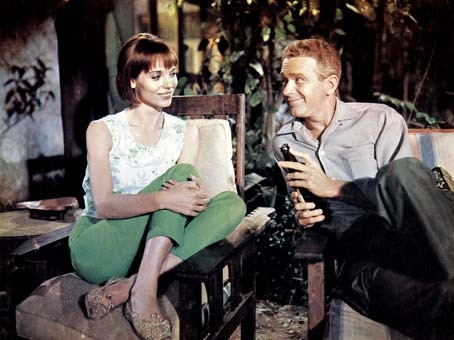
The choice of the cast was bold, but from boldness come the best works. Yves Montand plays Robert, a cosmopolitan war reporter. Annie Girardot plays Catherine his wife, a women Robert looks up to culturally, almost filially. Candice Bergen plays Candice, a passing flame in Robert’s life, a sort of adultery incentive that becomes the return point in the couple’s relation. Any love story must begin, or restart with the Truth.
http://www.youtube.com/watch?v=pJENpW7Itms

Cast and crew:

Directed by Claude Lelouch
Music composed by Francis Lai
Yves Montand, Annie Girardot, Candice Bergen
1967

Monday, November 15, 2010

EL CID, the Man who rises above the Legend


“There is only a man in Spain who could humble a king and would give a leper water to drink from his own pouch”, a Hero that having lived so long ago remains, still, a beacon of passion and honour. Director Anthony Mann drew, in El Cid, the character Rodrigo Diaz de Bivar as if time had suddenly, mysteriously, turned back to Medieval Age, in all its glory.

Charlton Heston, as main player, gave the character the divine breath and made him human again. The sceneries and wardrobe were carefully conceived. Dialogs sequences were artfully built. By the world Rodrigo is recognized as having been great. Many are the legends that keep his memory alive. But for Spain and Portugal, this film portrays a budding time for two countries that share the same blood and are siblings.


The story is set in the Twelve Century. The Iberian Peninsula was then divided by two cultures and religions, in Christian kingdoms and Moorish kingdoms. King Ferdinand of Castile Leon and Asturias is at war with the Moors and sends one of his bravest knights into battle – Rodrigo Diaz de Bivar. In his wedding day, Rodrigo on his way to his bride Ximene, fights the Moors but his heart is full of love and he decides to spear the prisoners. One of them, an Arab king, becomes deeply touched and blesses Rodrigo with this words “Among our people we have a name for a man with the vision to be just and the courage to be merciful. We call such a man El Cid. I Moutamin, Emir of Saragossa, swear loyal legion to King Ferdinand and to the Cid of Bivar”. But other knights, their hearts full of envy, find in this a splendid opportunity to harm Rodrigo and accuse him of treason. His father, Don Diego, defends him and, consequently, is humiliated by Ximene’s own father. Rodrigo must protect Don Diego’s honour but still tries to reason with the offender. There is a duel to the death and Rodrigo wins. Now, Ximene (one of Sophia Loren’s finest roles) is torn by the passion that links her to Rodrigo and the desire to avenge her father. So begins this story, so begins the path for El Cid’s glory, for this movie is more than the dwelling of a man and a woman. It is an example of the courage that rises above small things, of tolerance, respect and self sacrifice that come from great people.


The characters in the film bear a striking resemblance to the real ones which contributes to hold the viewer attention.
As a mean to share my national pride, I must add a small historic note. Not long after El Cid’s time, King Ferdinand’s son Alphonsus would present his illegitimate daughter Teresa with a county – Condado Portucalense. At the age of sixteen, Afonso Henriques her son, would claim the right to also be king on the ground of being grandson of another king and refused to be taxed. Portugal was born. The Hispanic kingdoms would slowly be united into forming Spain as a whole. Spain and Portugal were separated by history but both lands are warmed by El Cid’s deep red blood.

When beauty joins greatness the result is perfection in motion. Miklos Rozsa’s soundtrack and Anthony Mann’s direction… May the viewer decide which is which.
One of he most sublime work of art in Cinema, El Cid will change you as he has changed history.


Cast and crew and scene from the movie:


Last scene (link): in this scene the Cid had been mortally injured but made his wife swear that she would make it so that he would ride into battle alive or dead, the next day. And he was dead the next day, under his armour http://www.youtube.com/watch?v=v5e1L5ocXUw
Directed by Anthony Mann
Produced by Samuel Bronston
Music by Miklos Rozsa
Charlton Heston (as El Cid), Sophia Loren (as Ximene), Genevieve Page (as Urraca), Ray Valone, John Fraser, Gary Raymond, Hurd Hatfield, Massino Serato, Hubert Lom and Douglas Wilmer (as Moutamin)...

Saturday, November 6, 2010

HATARI!, a wild comedy directed by Howard Hawks


Three baby elephants, a rocket to catch five hundred small monkeys and a “green horn” female photographer are the ingredients of Howard Hawks hilarious comedy “Hatari!” The word that means “danger” in Swahili works like a charm as the title for this movie, set in the National Wild Park of Tanganyka.
An ex-bull fighter, an ex-racing pilot, an Indian named Little Wolf, an ex-taxi driver who freaks out at the sight of anything wild, a bad tempered Irishman and a cheetah named Sonya are some of the members of the odd crew that captures animals for zoos. All they need to complete the team is a photographer whose job would be documenting the captures. Their prayers, however, are answered in an awkward way when the missing team member turns out to be a red Italian woman in a tight dress and high heels. But the “boom is about to be lowered” when she decides to adopt three orphan baby elephants against any sense or reasoning.
The out sanding sound track by Henry Mancini gives Hatari! a heart beat. The landscapes in which the movie is set will make you want to move to Africa and stay there for ever – and for this a reference should be made to director of photography Russel Harlan, whose amazing artistic work sets the tone.
More than a light, happy comedy, Hatari! has what any artistic intervention should have – that stardust magic that makes you want to be a better person, that makes you want to let go of anything small or ordinary. It’s the kind of movie that kicks you out of your shell and into the world.
John Wayne playing the bad tempered Irishman and Elsa Martinelli playing the surprising female photographer are a bold – yet successful – match for the romantic pair. Hatari indeed!


Cast and Crew


Directed by Howard Hawks


Music by Henri Mancini


Director of photography Russel Harlan


Cast: John Wayne, Elsa Martinelli, Red Buttons (as Pockets)...

Thursday, November 4, 2010

GHOST LIFE


Roman Polansky latest film THE GHOST WRITER is far more than a subtle reference to Tony Blair´s policy. It is about more than little things like dirty secrets or the structural line it shows. In fact, it is about the truth in all its forms. Something our old cozy society long ago forgot… or perhaps the quest for the truth was never Man´s attitude towards life. Each character pretends to be something they are not, specially the ghost writer himself who never signs his works and shapes his style according to the public figure portrayed. Curiously, such strong message is not Polansky´s best work, his personal problems may have affected the final polish that makes a film great or close to a disaster. Not a disaster, in this case nor a success. However Polansky can’t help filming well, and the message that lies beneath came through. THE PATH FOR HAPPINESS IS THE COURAGE TO BE ONESELF. Life is too damn important to be wasted in undignified actions. Polansky sets the challenge for us to build a proper society, but deep inside doesn’t consider it possible. The movie ends badly because Fate herself kills the Ghost Writer as he is trying to bring out the truth from the shadows. Should we be pessimist as well? I say NO!


Cast and crew:


Hired by a big shot publisher, a young striving writer (played by Ewan McGregor) finds his dreams of glory put to the ground when asked to be a ghost behind UK's PM autobiography. It means good money, so he accepts despite his disappointment. But the real challenge is about to begin when McGregor's character becomes haunted by the former ghost writer misteriously... killed.

Directed by Roman Polansky

Starring: Ewan McGregor, Pierce Brosnan (as PM), Kim Cattrall...